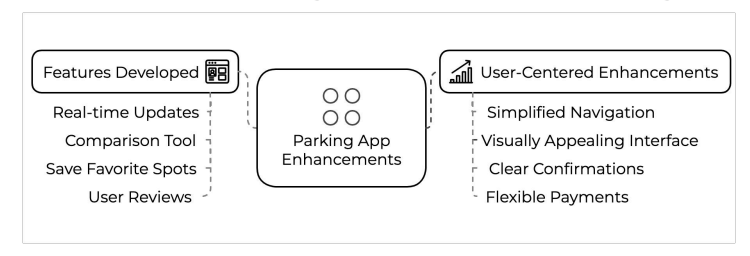
ParkSmart is a mobile application designed to simplify how drivers find and reserve parking in large cities. Through user research, competitive analysis, and iterative design, our team developed a streamlined solution that centralizes real-time availability, pricing transparency, and navigation into one seamless experience.
UX/UI Design • Product Strategy • User Research • 14 Weeks • iOS & Android • 15+ Screens
Open ParkSmart

UX Designer & Product Strategist
Team of 4 Designers
14 Weeks
Figma • Miro • Google Forms
Web Design Project
iOS
Reduce time spent finding parking, provide clear real-time availability, lower stress, simplify the process, improve navigation, and create a more intuitive interface.
User insights highlighted time, stress, and uncertainty as key pain points. Competitive review of ParkMobile and SpotHero revealed gaps. Journey mapping identified friction points, while personas (students, commuters, event-goers) kept the design user-focused. Usability prioritized clarity and simplicity, and the design was iteratively refined based on feedback.
Apps like ParkMobile and SpotHero focus on payments, not real-time availability. Most rely on static or user-reported data, making info outdated. Navigation tools show locations but don’t reduce the stress of finding a spot, and the experience often feels fragmented—highlighting the need for a more intuitive, real-time, end-to-end solution.
Finding convenient and affordable parking in large cities is time-consuming and frustrating. Drivers often compare multiple apps, encounter outdated availability data, and overpay due to limited pricing transparency. The fragmented experience creates unnecessary stress during everyday travel.
We identified an opportunity to consolidate real-time availability, pricing comparisons, and reservation capabilities into one intuitive mobile platform. By focusing on clarity, speed, and trust, ParkSmart aims to reduce user stress and improve decision-making in high-pressure situations.
ParkSmart primarily serves urban drivers and students navigating dense city environments. Our research focused on users aged 18–35 who frequently rely on mobile apps, prioritize affordability, and value efficiency. Many expressed frustration with inconsistent availability data and lack of cost clarity in existing solutions.